

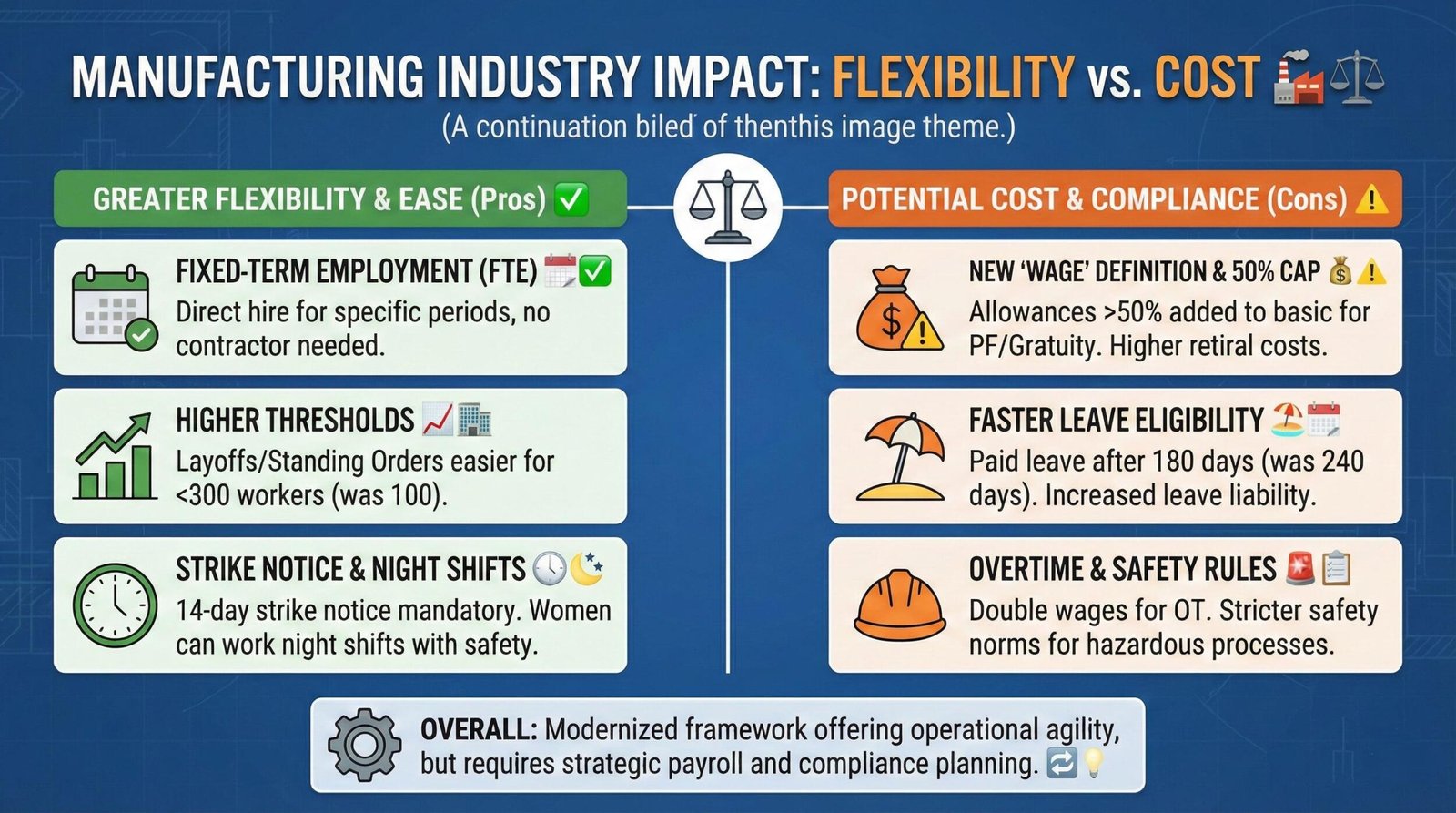
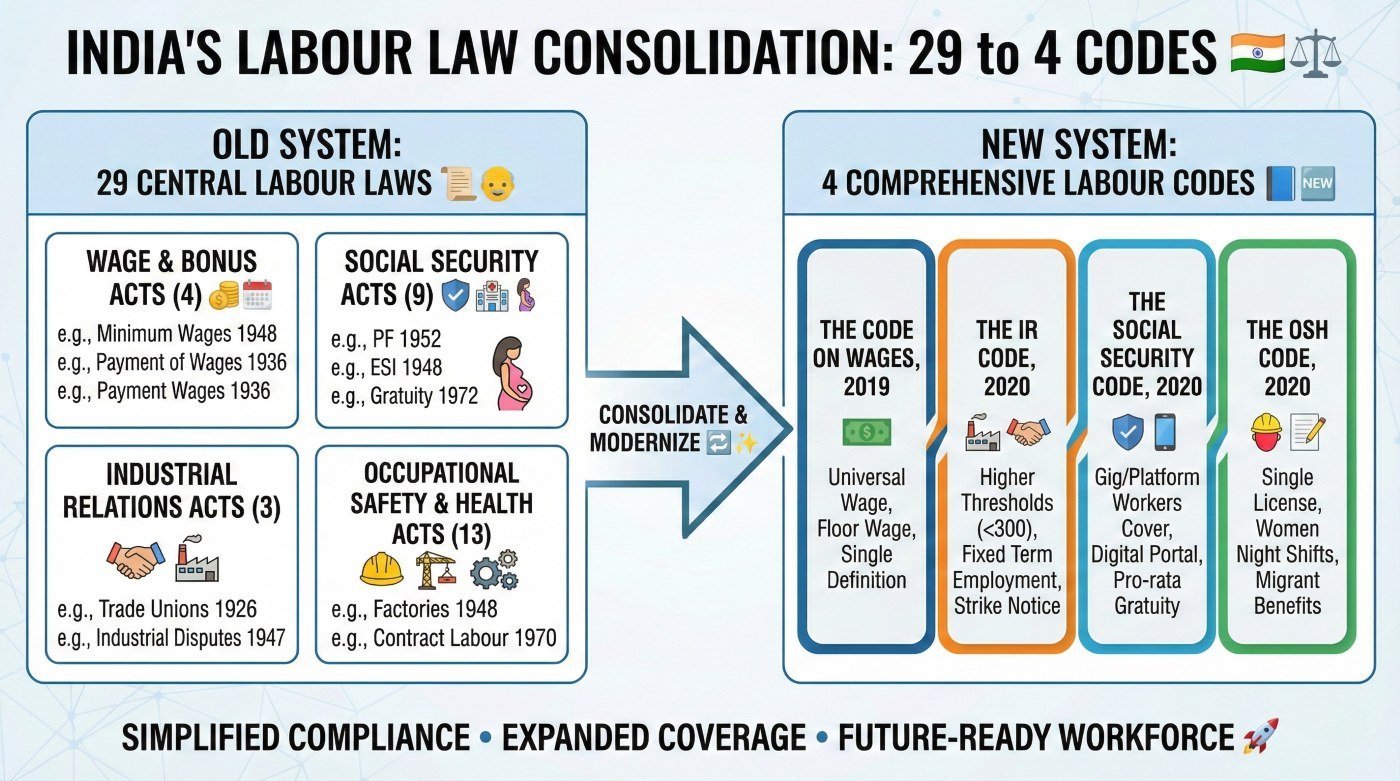
For Manufacturing Industries (factories, foundries, production plants, etc.), the shift to the 4 Labour Codes is a major overhaul. The new system generally offers more operational flexibility (hiring/firing/shifts) but may increase payroll costs due to the new definition of “Wages.”
Here is the specific impact on the Manufacturing sector:
1. Operational Flexibility (Hiring & Shifts)
The most significant relief for manufacturers comes from the Industrial Relations (IR) Code and OSH Code, which relax the rules for managing the workforce.
-
Higher Threshold for “Standing Orders”:
-
Old System: Factories with 100+ workers had to have certified “Standing Orders” (rigid rules for classification, shifts, and termination).
-
New System: This threshold is raised to 300+ workers.
-
Impact: Factories with fewer than 300 workers have full flexibility to hire, fire, and manage shifts without seeking government certification for their rules.
-
-
Fixed-Term Employment (FTE):
-
New System: You can now directly hire workers for a fixed period (e.g., 6 months for a specific order) without using a contractor.
-
Impact: You can treat them as regular employees for that duration. They get pro-rata gratuity (even if they work less than 5 years) but you are not obligated to keep them after the term ends.
-
-
Contract Labour Threshold:
-
Old System: Applied if you had 20+ contract workers.
-
New System: Applies only if you have 50+ contract workers.
-
Impact: Smaller units can use contract labour with less compliance paperwork. Note: Contract labour is generally prohibited in “Core Activities” of the manufacturing process unless the activity is fluctuating/seasonal.
-
-
Women in Night Shifts:
-
New System: Women are legally allowed to work in night shifts (7 PM – 6 AM) in factories, provided you ensure safety, working conditions, and obtain their consent.
-
2. Financial Impact (The “50% Rule”)
The Code on Wages introduces a change that could increase your monthly payroll and retiral burdens (PF and Gratuity).
-
New “Wage” Definition:
-
The Rule: “Wages” = Basic + DA + Retaining Allowance. If other allowances (HRA, Overtime, Conveyance, etc.) exceed 50% of the total remuneration, the excess amount is added back to “Wages” for calculating PF and Gratuity.
-
Manufacturing Context: Factories often have low Basic pay and high allowances (Production Incentive, Night Shift Allowance, Heat Allowance).
-
Impact: If your allowances are high, your PF contribution and Gratuity liability will likely increase significantly.
-
3. Factory Compliance & Safety (OSH Code)
The Occupational Safety, Health and Working Conditions (OSH) Code subsumes the old Factories Act, 1948.
-
New “Factory” Definition:
-
Old: 10 workers (with power) / 20 (without power).
-
New: 20 workers (with power) / 40 workers (without power).
-
Impact: Very small micro-units are now outside the strict “Factory” regulations.
-
-
Single License:
-
Instead of renewing multiple licenses (Factory license, Contract labour license, etc.), you will have a single all-India license valid for 5 years.
-
-
Leave Eligibility:
-
Workers now qualify for earned leave after working 180 days (previously 240 days). This means temporary workers will qualify for paid leave faster.
-
-
Safety Committees:
-
Mandatory only for factories with 500+ workers (dealing with hazardous processes may have stricter norms).
-
4. Unions and Strikes (IR Code)
-
Flash Strikes Banned:
-
Union workers cannot go on a “flash strike.” They must give a 14-day notice before any strike. This is critical for continuous process industries (like furnaces/foundries) where sudden stoppages cause damage.
-
-
Sole Negotiating Union:
-
If you have multiple unions, you only need to negotiate with the one that holds 51% of the workforce. You don’t need to deal with every small union.
-
Summary: Good vs. Bad for Manufacturing
| Feature | Impact on Manufacturer |
| Fixed Term Employment | ✅ Positive: Easier to manage seasonal/order-based demand. |
| Layoff Limits (300+ rule) | ✅ Positive: Easier to right-size workforce for mid-sized factories (<300 staff). |
| Strike Notice | ✅ Positive: No sudden production halts; 14-day warning mandatory. |
| Overtime | ⚠️ Neutral: Must pay double wages; consent required; generally capped at 125 hours/quarter (varies by state rules). |
| Wage Cost | ❌ Negative: PF and Gratuity bills may rise due to the “50% allowance cap.” |
| Leave Entitlement | ❌ Negative: Workers qualify for paid leave faster (180 days vs 240). |






Leave A Comment