

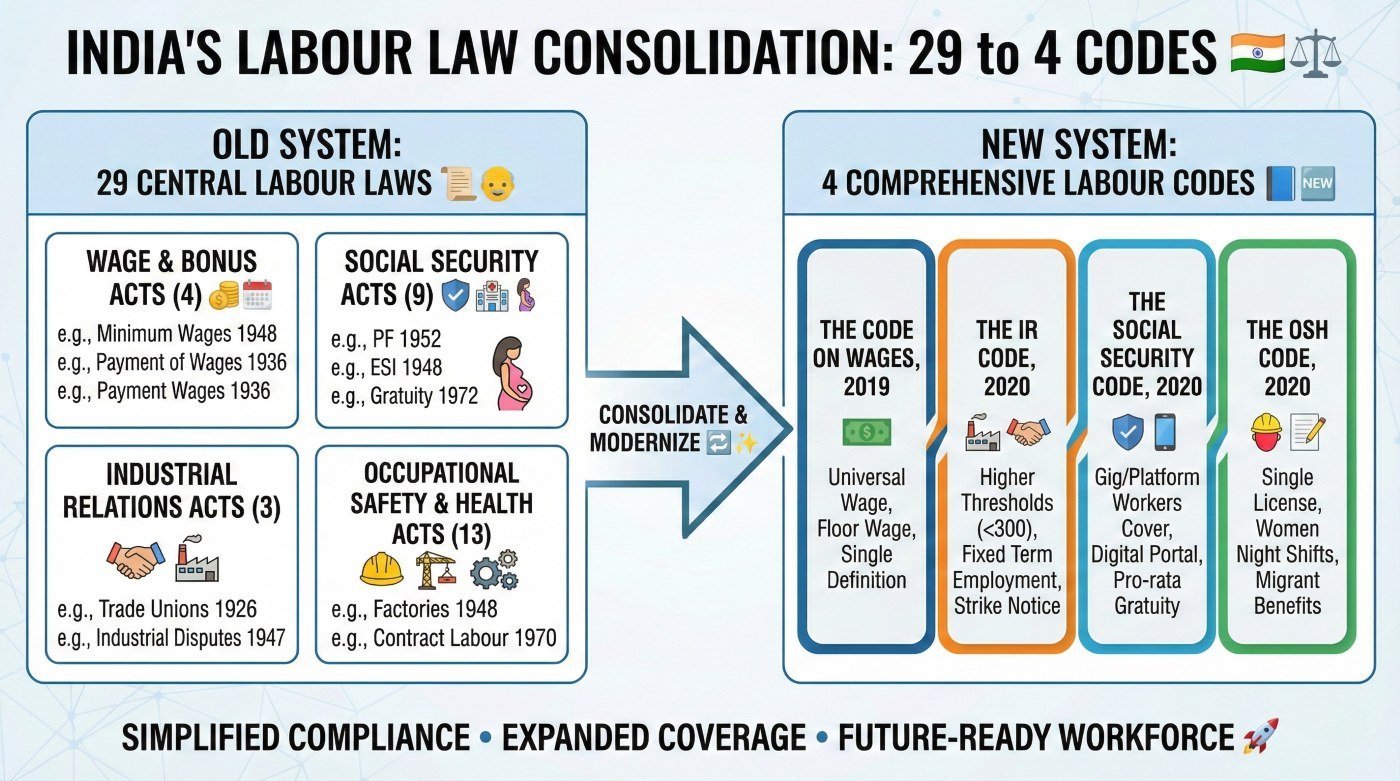
The Government of India has consolidated and amalgamated 29 central labour laws into 4 comprehensive Labour Codes. This move aims to simplify the complex compliance landscape, modernise outdated provisions, and extend social security to all workers (including gig and platform workers).
Below is the complete list of the 29 old laws and how they have been merged into the new system.
1. The Code on Wages, 2019
Focus: Regulating wage rates, bonus payments, and equal remuneration.
Old Laws Subsumed (4 Acts):
-
The Minimum Wages Act, 1948: Governed minimum wage rates.
-
The Payment of Wages Act, 1936: Ensured timely payment without unauthorized deductions.
-
The Payment of Bonus Act, 1965: Mandated annual bonus for employees in certain profit/production scenarios.
-
The Equal Remuneration Act, 1976: Prohibited gender discrimination in payment.
How it Merges & Changes:
-
Universal Applicability: Unlike the old laws which applied to specific “scheduled” employments, the new Code applies to all employees across all sectors.
-
Floor Wage: The Central Government will fix a “Floor Wage.” State governments cannot fix minimum wages below this floor.
-
Unified Definition: A single definition of “Wages” is introduced to reduce litigation and confusion (generally: Basic + DA + Retaining Allowance).
2. The Industrial Relations (IR) Code, 2020
Focus: Trade unions, strikes, lockouts, layoffs, and retrenchment.
Old Laws Subsumed (3 Acts):
-
The Trade Unions Act, 1926: Registered and protected trade unions.
-
The Industrial Employment (Standing Orders) Act, 1946: Required employers to define conditions of employment (standing orders).
-
The Industrial Disputes Act, 1947: Governed layoffs, retrenchment, and dispute resolution.
How it Merges & Changes:
-
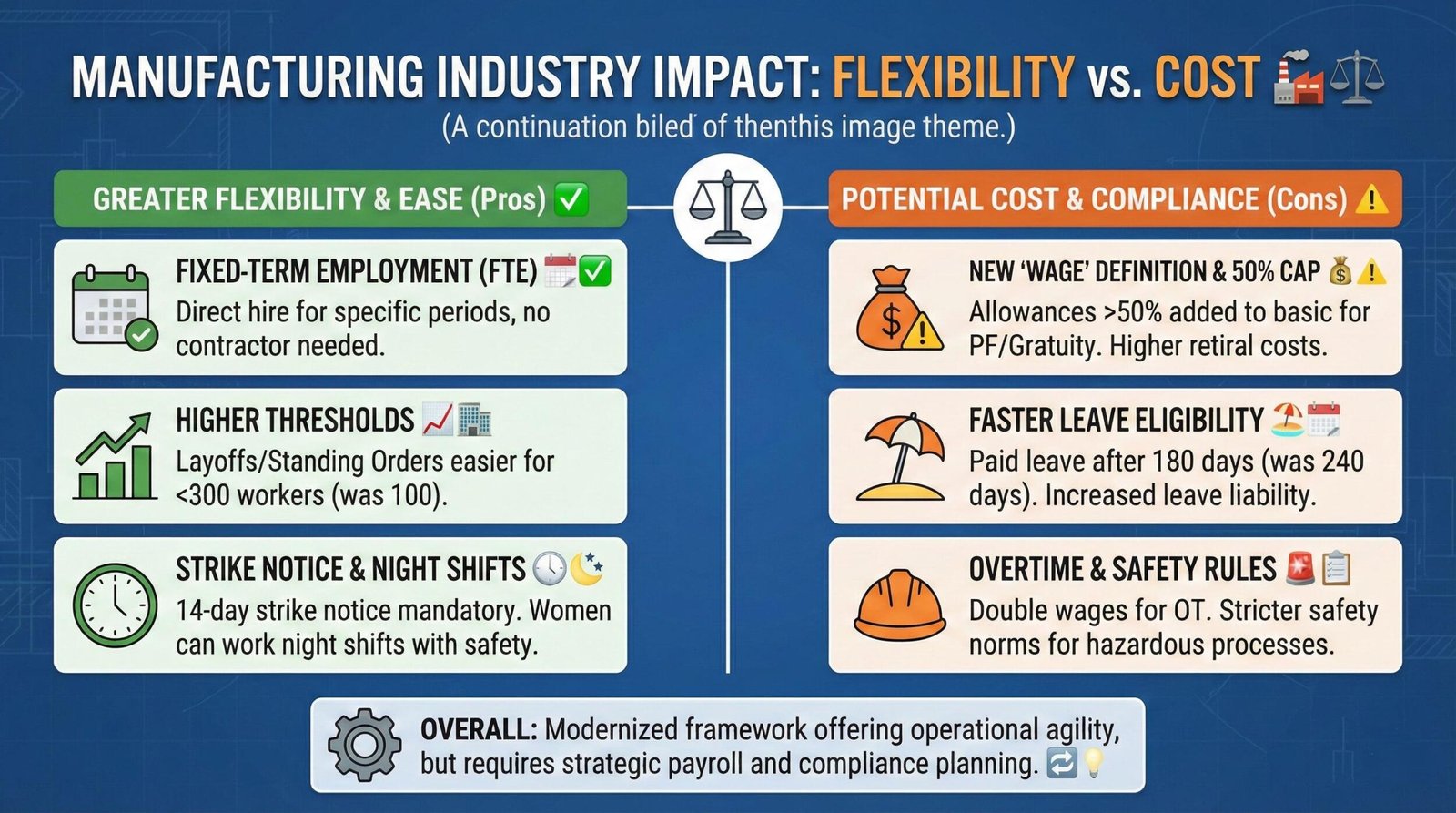
Increased Thresholds: The requirement to have certified “Standing Orders” now applies only to establishments with 300 or more workers (previously 100).
-
Fixed Term Employment: Formally introduces “Fixed Term Employment,” allowing employers to hire contract workers for a specific duration with full statutory benefits (like pro-rata gratuity), reducing reliance on contractors.
-
Sole Negotiating Union: If there are multiple unions, the one with 51% or more workers as members will be recognized as the sole negotiating agent.
3. The Code on Social Security, 2020
Focus: Social security benefits like PF, ESI, gratuity, and maternity coverage.
Old Laws Subsumed (9 Acts):
-
The Employees’ Provident Funds & MP Act, 1952: Retirement savings (PF).
-
The Employees’ State Insurance Act, 1948: Medical and sickness benefits.
-
The Payment of Gratuity Act, 1972: Gratuity payment after 5 years of service.
-
The Maternity Benefit Act, 1961: Paid leave for women during maternity.
-
The Employees’ Compensation Act, 1923: Compensation for workplace injuries.
-
The Employment Exchanges (Compulsory Notification of Vacancies) Act, 1959: Reporting vacancies.
-
The Cine Workers Welfare Fund Act, 1981: Welfare for cinema workers.
-
The Building and Other Construction Workers Welfare Cess Act, 1996: Cess collection for construction workers.
-
The Unorganised Workers’ Social Security Act, 2008: Welfare for unorganised sectors.
How it Merges & Changes:
-
Gig & Platform Workers: For the first time, social security schemes (life, disability, health, etc.) are extended to gig workers (e.g., Uber/Zomato drivers) and platform workers.
-
Digitisation: Mandates Aadhaar-based registration for all unorganised workers on a national portal (e-Shram).
-
Gratuity: Fixed-term employees are now eligible for gratuity on a pro-rata basis, even if they work for less than 5 years.
4. The Occupational Safety, Health and Working Conditions (OSH) Code, 2020
Focus: Safety standards, health, welfare, and working hours.
Old Laws Subsumed (13 Acts):
-
The Factories Act, 1948: Safety in factories.
-
The Mines Act, 1952: Safety in mines.
-
The Dock Workers (Safety, Health and Welfare) Act, 1986: Safety in ports/docks.
-
The Contract Labour (Regulation and Abolition) Act, 1970: Regulated contract labour.
-
The Inter-State Migrant Workmen Act, 1979: Protected migrant workers.
-
The Plantations Labour Act, 1951: Welfare for plantation workers.
-
The Working Journalists and Other Newspaper Employees Act, 1955: Conditions for journalists.
-
The Working Journalists (Fixation of Rates of Wages) Act, 1958: Wage rates for journalists.
-
The Motor Transport Workers Act, 1961: Drivers/conductors welfare.
-
The Sales Promotion Employees Act, 1976: Medical reps/sales staff welfare.
-
The Beedi and Cigar Workers Act, 1966: Beedi workers welfare.
-
The Cine Workers and Cinema Theatre Workers Act, 1981: Cinema employment regulation.
-
The Building and Other Construction Workers (Regulation of Employment) Act, 1996: Safety in construction.
How it Merges & Changes:
-
One License: Replaces multiple registrations with one single license for the establishment.
-
Factory Definition: The threshold to be defined as a “Factory” is raised to 20 workers (with power) and 40 workers (without power), up from 10/20.
-
Inter-State Migrant Workers: The definition is expanded to include workers who migrate on their own (not just those brought by contractors), entitling them to journey allowances and portability of benefits (One Nation, One Ration Card).
-
Women in Night Shifts: Allows women to work at night (7 PM to 6 AM) in all establishments, provided safety and consent protocols are followed.
Summary Table of Consolidation
| New Code | Number of Old Laws Merged | Key Impact |
| Code on Wages | 4 | “Right to Minimum Wages” for all; Single “Wages” definition. |
| IR Code | 3 | Easier hiring/firing for firms <300 staff; Fixed Term Employment legalised. |
| Social Security Code | 9 | Social security for Gig/Platform workers; Universal registration. |
| OSH Code | 13 | Single license; Annual health check-up for older employees; Women can work night shifts. |
| Total | 29 | Modernization & Simplification |





Leave A Comment